

THE INSTITUTE’S DIRECTOR PARTICIPATED AS A PANELIST AT THE “BOOKING HEALTH IN SRPSKA” HEALTH TOURISM CONFERENCE
The Director of the Public Scientific Research Institution “Institute for Protection and Ecology of the Republic of Srpska,” Prof. Dr. Predrag Ilić, participated as a panelist at the Second International Health Tourism Conference “Booking Health in Srpska,” held on March 24 and 25, 2026, at the Courtyard by Marriott Hotel in Banja Luka.
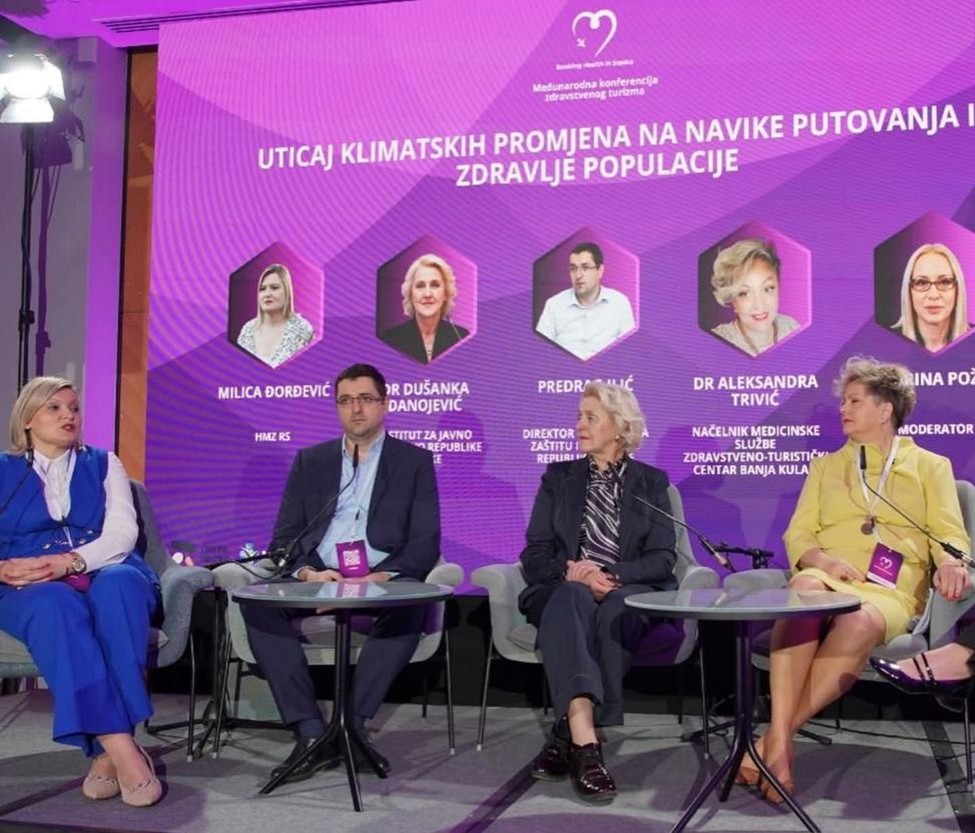
Prof. Dr. Ilić took part on the second day of the conference, March 25, 2026, in the panel discussion titled “The Impact of Climate Change on Travel Habits and Population Health.” In addition to Prof. Dr. Predrag Ilić, the panel included Milica Đorđević from the Hydrometeorological Institute of Republika Srpska, Dr. Dušanka Danojević from the Institute of Public Health of the Republic of Srpska, and Dr. Aleksandra Trivić from Banja Kulaši, with Katarina Požgaj as moderator.
During the panel discussion, Prof. Dr. Ilić spoke about the importance of air quality, preserved ecosystems, and favorable climatic characteristics as increasingly important factors in the context of population health, climate resilience, and the development of health tourism. In his presentation, he particularly emphasized that Republika Srpska has areas with very high air quality and favorable natural conditions, which are gaining additional strategic importance in a time of climate change.
Special emphasis was placed on the potential of air spas and health-recreational climatic zones as resources that can contribute to health preservation, preventive and rehabilitation stays, as well as sustainable tourism development. In this context, it was highlighted that certain areas in Republika Srpska have already been recognized as air spas, while other locations also show strong potential for further development in accordance with expert analyses and clearly defined criteria.
Speaking about the challenges of climate change, Prof. Dr. Ilić also pointed to the need for an integrated approach, involving cooperation among the sectors of environmental protection, healthcare, tourism, spatial planning, forestry, and local communities. It was emphasized that naturally preserved areas should not be viewed as spaces for rapid exploitation, but rather as long-term resources that must be protected, carefully used, and developed in a sustainable manner.
The participation of the Institute’s Director in this conference represents yet another confirmation of the Institute’s active role in professional discussions on topics that connect environmental protection, climate change, public health, and sustainable development. At the same time, this appearance contributed to promoting the importance of a science-based approach in identifying and preserving natural values that may play an important role in the future development of health tourism in Republika Srpska.